
Author: Stéphane Husar
Illustrator: Loïc Méhée
Publisher: abc MELODY
Year: 2020
Language: English
Resource type: Illustrated picture book in English
Themes: First day of school, school supplies, classroom routines, playground games, lunch, friendship
Age range: 5–8 years
School levels: Grade 1, Grade 2, Elementary (K–5)
Main learning objective: Learn school-related vocabulary and classroom routines in English through listening and speaking activities
Main language objective: I can spell my name. I can name items in my schoolbag. I can say what I have for lunch.
Summary of the Book
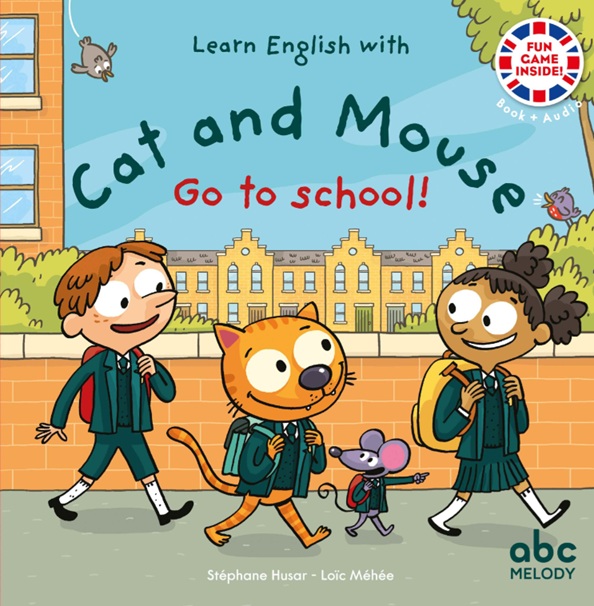
In this engaging picture book, Cat and Mouse experience their very first day at school. They meet their teacher, Mrs Bloom, discover classroom objects, and take part in different activities: writing, drawing, playing in the playground (with games such as hide-and-seek, plus fun onomatopoeias and sound effects), and looking at a world map. At lunchtime, they share what’s inside their lunchboxes. The day ends with a warm reminder of the joy of making new friends.
Culture and Vocabulary
The book introduces children to Anglo-Saxon school culture. While many elements are universal (first day of school, meeting classmates, recess), others are more specific: addressing the teacher as “Miss” and having a lunchbox—common in English schools. This offers young learners a first intercultural experience, inviting them to compare school life in England and in their country.
School objects: paper, ruler, schoolbag, eraser, pencil, pen, glue, textbook, pencil case, exercise book, colored pencils
School places & times: school, desk, whiteboard, playground, lunchtime, break time
Action verbs: greet, spell, sit down, take, draw, play, count, go to the playground, write, look, eat
Polite expressions: Good morning, Sorry Miss, Thank you, Enjoy your meal
Classroom phrases: Take your textbook and a pen, Go to your desk and sit down, Do you have everything in your schoolbag?, Let’s write the alphabet, Can you spell your name?, Well done
Food vocabulary: cheese, lettuce, milk, biscuits, sausage, yogurt, pasta, pizza
Onomatopoeias & sound effects: KNOCK! KNOCK!, RING, tweet tweet, squeak, woof, oink, ooh ooh, aah aah
Geography words: map, World, Europe, England, France, Italy
Numbers: one to ten
Grammar and Structures
- Simple present: Today is the first day of school for Cat and Mouse. / I love school! – stating facts, likes, and opinions.
- Greetings & introductions: Good morning, children! My name is Mrs Bloom.
- Questions with Do you…?: Do you have everything in your schoolbag?
- Polite imperatives: Take your textbook and a pen, please.
- Negation + instructions: Don’t worry. Go to your desk and sit down, please!
- Modal can for ability/requests: Can you spell your name, please?
- Future with be going to: We are going to learn to write.
- Possessives: your schoolbag
- Plurals & countable nouns: books, pencils, rulers
- Spelling practice: C-A-T, M-O-U-S-E
- Expressing similarity: So do I!
- Exclamations & encouragements: Well done!, Sorry Miss!
Phonology
- Onomatopoeias and sound imitation: Knock knock! Ring! Woof! Squeak! – helps with intonation and engagement.
- Vowel contrasts: Cat (/æ/) vs Mouse (/aʊ/)
- Consonant clusters: school (/sk/)
- Counting rhythm: One, two, three… ten!
- Animal sounds: Woof, Oink, Squeak – fun and phonologically rich
- Spelling aloud: C-A-T, M-O-U-S-E – segmentation and sound-letter awareness
- Sibilant sounds [s] vs [z]: mouse, cheese, sausage
- Intonation in instructions: Sit down, please!
- Expressive exclamations: Well done! Sorry Miss!
Teaching Suggestions
Before Reading
- Show the cover and ask prediction questions: Who are Cat and Mouse? Where are they going?
- Introduce school supplies using real objects or flashcards.
- Teach essential classroom instructions (Take, Sit down, Open your book).
- Review numbers 1–10 orally.
During Reading
- Pause to identify and name objects in the illustrations.
- Have children repeat polite expressions (Good morning, Thank you, Sorry Miss) with correct intonation.
- Act out classroom instructions together.
- Invite students to spell their own names, just like Cat and Mouse.
After Reading
- Matching game: match flashcards of school supplies.
- Role play: act out the first classroom scene (greeting, instructions, responses).
- Food sorting: classify lunchbox items into “healthy” vs “sometimes foods.”
- Map activity: locate England, France, Italy on a simple map.
- Writing task: In my schoolbag I have… (list or short paragraph).
Mini Grammar Lesson
- Practice Do you have…? with classroom objects.
- Reinforce So do I for common likes (I like pizza. So do I!).
- Use the simple present with characters’ actions.
- Practice colors + possessives (my red pencil, my blue exercise book).
Cross-Curricular Connections
Civic Education: greetings, thanking, apologizing in another language.
Art: create or decorate a lunchbox or schoolbag.
Songs & Chants: Hello Song, Good Morning Song, or counting songs (Super Simple Songs).
Geography/EMI: explore a world map and locate countries.
Math: count to ten in English.
Science/Health Education: talk about lunchbox food and healthy choices.
Language & Literacy: spelling names, reading short words.
PE: play hide-and-seek in English during recess.
Music: sing The Alphabet Song.
Project Ideas
Class Project: “My Schoolbag in English”
Each student designs a paper schoolbag and fills it with illustrated supplies labeled in English. The final work can be displayed in the classroom.
Explore Other Books on School
Read Maisy Goes to Preschool by Lucy Cousins or Spot Goes to School by Eric Hill to expand vocabulary and compare different school stories.
Conclusion
Learn English with Cat and Mouse Go to School! is a fun and effective resource for teaching English to young learners. With relatable characters and a realistic school-day storyline, it provides a natural way to learn classroom vocabulary, routines, and polite expressions.
The grammar structures are simple and age-appropriate, while the teaching possibilities are endless: role-plays, spelling games, songs, art projects, and cross-curricular links. This book is a valuable tool for developing listening and speaking skills, early reading, and cultural awareness—while keeping the joy of communication at the heart of learning English.